Showing posts with label History of Gaming. Show all posts

Tuesday, 17 December 2013

History of Gaming: Part 4.

The start of the 00's, Sega had stopped production of the Dreamcast, leaving the market open for another competitor. Sega had decided to produce games for other platforms otherwise they'd run the risk of going under, this shocked many of the fans as the console had so much potential. (Fahs, T 2010) Sony had released the Playstation 2 at the start of the decade and the console was selling very well, while Nintendo was about to release the Gamecube meaning the market was already shaping up for another fight.

At the end of 2001, Microsoft decided to step into the ring by releasing the Xbox. Microsoft had the money and the knowledge to step into the market and while the console didn't sell as much as the Playstation it certainly showed that Sony didn't have a firm grip on the lead position. The Xbox released with Halo: Combat Evolved and year later Xbox Live was released, so the console certainly had a few tricks, but it also had a few missteps, like the original "Duke" controller which was the size of a small car (Certainly felt that way). (Goss, P 2011)

[1]

During this decade many of the big game franchises started to pick up, such as Grand Theft Auto. GTA III was released in 2001 and this was the games first 3D outing, and since then had been one of the top selling franchises in the gaming industry. Call of Duty was released in 2003 and while it wasn't the mega-blockbuster it is now, it certainly shows what games can become with a decent developer, time and an eventual endless money pit. Nintendo were also releasing their usual games for the Gamecube, such as Smash Bros, Zelda and the multiple Mario games, all of which sold well.

The Playstation 2 has now become the best selling console in history, selling over 150 million units, yet the next generation wasn't going to be as easy for Sony. In 2005 Microsoft had rushed into the next generation of consoles with the Xbox 360, they had learned from their past mistakes and also built upon their old successes with Xbox Live. The end of 2006 saw Sony and Nintendo enter the next-gen with the Playstation 3 and the Wii. The Xbox 360 had hardware problems with the dreaded Red Ring of Death, while the Playstation 3 had a very high price point and shaky online features. The Wii on the other hand found success in the innovative motion-controls and the usual high quality Nintendo games.

These sort of families appeared on our TV's  [2]
The difference between the PS3 and the 360 eventually came down to the exclusive games. The 360 had the Halo franchise, Gears of War, Forza and a few other one offs, such as Mass Effect or Lost Odyessy. The PS3 on the other hand had Kill Zone, Gran Turismo, Uncharted and others. The cross-platform games are almost identical in every way and this seems to be continuing across to the new generation that has just been released.

It is hard to tell who will win the new generation. Microsoft will have to work hard to regain some lost sales due to a terrible E3, while Sony and the PS4 at the moment appear to be the golden company. Nintendo are doing what they do best with the WiiU, yet the WiiU hasn't picked up like the original Wii did. I imagine as more must-have Nintendo titles come out the console will sell. I've personally gone with the Xbox One for now, I was torn at first but I feel the starting line-up on the One is slightly stronger and I enjoy both the Forza and Dead Rising franchises.


References & Notes
Fahs, T. (2010). IGN Presents the History of Dreamcast. Available: http://uk.ign.com/articles/2010/09/10/ign-presents-the-history-of-dreamcast?page=10. Last accessed 15th Nov 2013.

Goss, P. (2011). Ten years of Xbox: a brief history. Available: http://www.techradar.com/news/gaming/consoles/ten-years-of-xbox-a-brief-history-1040866. Last accessed 17th Dec 2013.

http://us.playstation.com/corporate/about/theplaystationstory/

[1]http://images.thecarconnection.com/lrg/2013-volkswagen-golf-r-2-door-hb-side-exterior-view_100414823_l.jpg http://gearmedia.ign.com/gear/image/article/117/1176925/dukecontroller_1308247746.jpg

[2]http://lazytechguys.com/featured/top-20-family-friendly-video-games-of-2012/#.UrCXsfRdXuM

Monday, 25 November 2013

History of Gaming: id & the First Person Shooter.

It is without a doubt that the first-person shooter genre might not be as big as it is today without the help of id. Through out the 1990’s the company pushed the genre multiple times, helping place the FPS in the top spot for addictiveness and competitiveness. This post will briefly look over Id’s history with the genre and how they shaped it.

[1]
While id made the genre popular, they certainly did not invent it. Decades before, in 1973 a NASA intern named Steve Colley created a program that placed the user inside a maze, not just above it. The idea of 3D rendering at the time seemed far fetched but Colley and his co-workers figured mazes only needed 90 degrees angles, this made it much easier to create. The original game was boring, but 2 other interns, Greg Thompson and Howard Palmer saw potential in the program.

Thompson and Palmer had the idea to place more than 1 user in the maze and soon after shooting each other was introduced. At the start the game was passed around between friends but in 1974 Thompson returned to MIT and upgraded Maze Wars to run over an early version of the internet. Students battled it out across campus and the game grew in popularity, even being picked up by Xerox to port to other computers. (Olivetti, 2012) Maze Wars now appears to be mostly forgotten about, every resource I’ve read through so far seems to completely ignore it in the history of gaming, yet I believe it holds great significance in both the FPS genre and gaming in general with some of the first online multiplayer, a radar and a spectator mode.

In 1989, John Carmack met John Romero during a job interview for Softdisk. Both were very skilled programmers but Romero also had an artistic side. They also met Tom Hall and Adrian Carmack (no relation) there and began moon-lighting to create their own games, the first one being Commander Keen. Keen was a side-scrolling action game, very much like Mario but the people who played it said it was much better. The moon-lighting team began calling themselves Ideas From the Deep and eventually left Softdisk to create id Software, founded on February 1st, 1991.

J.Carmack - Front Left, Adrian Carmack - Hidden at the back, J.Romero - Middle, Tom Hall - Second from the right[2]

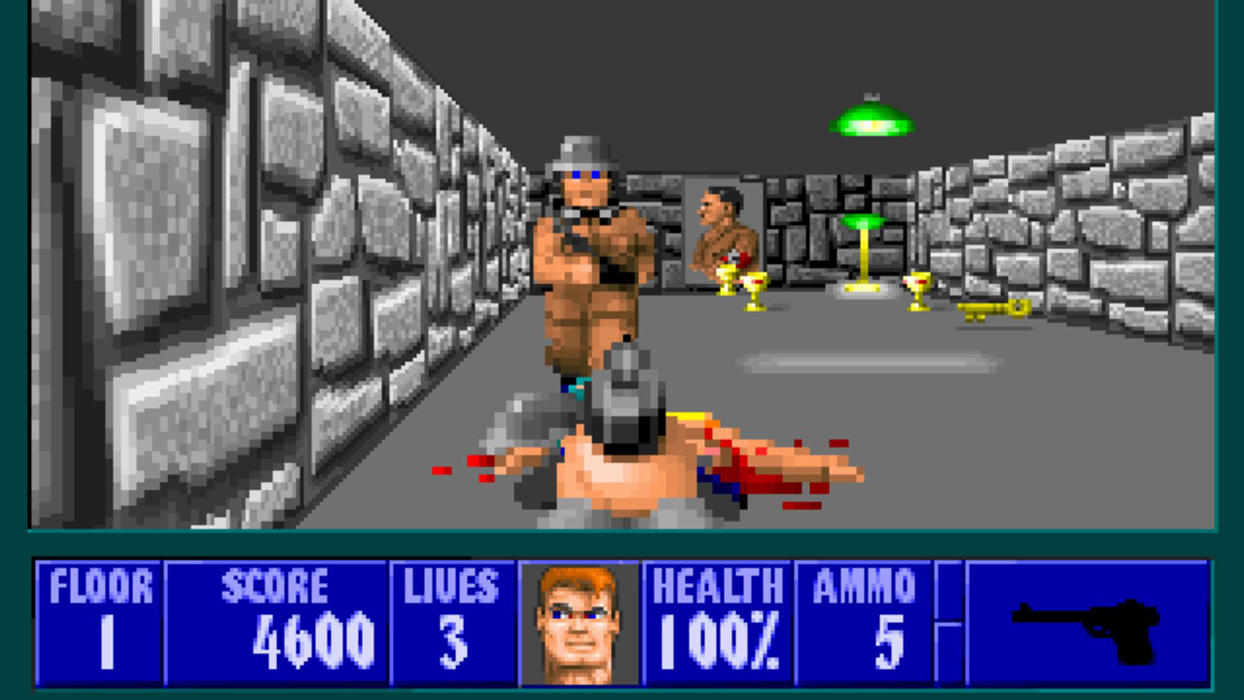
John Carmack, now id’s main programmer, wanted to create a fast-paced 3D game, instead of the slow 2D game, Commander Keen. After months of research Carmack and the others had come up with Hovertank. The game however was rather ugly due to the limitation of the computers at the time. Id continued work on Commander Keen to pay the bills and eventually wanted to explore the fast-paced 3D game again. The decision was made to recreate Wolfenstein by John Romero, an older stealth game that was well suited to Carmack’s engine. Romero also wanted the game to be bloody and violent, after growing up with films like Rambo and Friday the 13th, extreme violence had not been explored in video games yet. New technology such as texture mapping helped Wolfenstein 3D achieve a good visual style while also keeping the speed of the game high, the stealth elements were thrown away as they were “slowing the game down”. Wolfenstein 3D was released on May 5, 1992, with secret sliding doors, boss death cams, taunting difficulties and lots of violence and gore.

The game became an underground sensation. Internet forums and BBSs where filled with people talking about it. Eventually the media caught on and praised it too, even with all the violence. Wolfenstein 3D began to get hacked, or for a more modern term, modded. Due to the 3D nature it was more difficult to hack but this didn’t stop people replacing the enemies with Smurfs for example.

Wolfenstein 3D - No floor or roof textures yet [3]

John Carmack had again made advances with 3D rendering, creating an engine that enabled fading light and textures on walls and ceilings, he also had the idea to base their next game on demons with the title Doom. Carmack continued to push the engine, helping Romero and Adrian bring their demonic imaginations to life, while scrapping anything that would slow down the pace of the game, including the story. Tom Hall wanted to include a more cinematic story with Doom, yet Carmack said “Story in a game, is a like a story in a porn movie, it’s expected to be there but it’s not that important.”

Doom was released at the end of 1993, with faster gameplay, more violence, complex levels and multiplayer. A first person game of this speed had never included multiplayer before. Doom became an overnight hit, with any place having internet access grinding to a stop simply because people were playing. Intel and A&M had to take actions to stop their employees playing.

Doom - Roof and floor textures, with shadows! [4]

After seeing what modders had done with Wolfenstein 3D, Id made sure that Doom was much more accessible with WAD files, these allowed players to alter the game without destroying the code. Despite being so popular Doom was mostly an underground game, only available through shareware. Id worked on Doom II which would be released on CD-ROM, helping id so mainstream, while John Carmack began working on their next game engine.

Id grew, hiring more people to cope with the lengthening development time. Their next game would be Quake, they had planned this game for a while but their idea was different to the final out come. The original idea was for Quake to be a fantasy, melee combat game but as development became troubled id decided to stick with what they know - the FPS. One thing was certain though, the game would be playable over the internet from release, with 16 players. The various artists had all been in their own worlds while Carmack worked on the Quake engine, this lead to there being 3 distinct looks between the levels. Id stitched them together with a story about an invader using slipgates to assault different worlds.

[5]

Quake was released on June 22, 1996 and despite the rough development the game was a success... a massive success, due to Carmack’s ground-breaking engine and because the game was built from the start for multiplayer. Gamers played the game across LAN and the internet battling it out and forming clans. It didn’t take long for tournaments to begin and once this happened e-sports had begun. While gamers enjoyed Quake, Id had suffered during the development and the fallout hit them hard, with the majority of the talent leaving.They later released Quake II and thanks to Carmack’s coding was a success, but Id’s win streak was over.

April 20th, 1999, the Columbine killings took place, where 2 teenagers killed 13 others. Hours before, one of them recorded a video explaining his actions and he mentioned “it’s going to be like fucking Doom!”. This lead to a media storm over violence in video games and fingers were all pointed towards the creators of these games, such as id. Quake III was in development at the time but the pitchforks were already out. Gamers had also shifted in taste, but it’s unsure if the bad media was the reason. They wanted stories now, with games like Half-Life, System Shock and Marathon leading this change. To make things worst the development of Quake III was rough due to in-fighting and no real leadership, id began to fall apart again losing some of it’s newer members. (Kusher, 2003)

Half-Life: "Do you know who ate all the donuts?" [6]
This is where, in my opinion, the FPS left id’s hands and other companies began to push the genre. Companies like Rare brought quality first-person shooters to the console with Goldeneye 007, Bungie streamlined it with Halo 2 and Infinity Ward made it extremely popular with Call of Duty: Modern Warfare. Id’s latest game was RAGE released in 2011, while being technologically fantastic the gameplay didn’t do anything new and multiplayer was completely absent. The fate of the FPS is now open, with companies like DICE and Infinity Ward/Treyarch making little to no advancements for the genre, here’s hoping Valve has something ground-breaking in store with Half-Life 3.


Reference & Notes
Kushner, D (2003). Masters of Doom. London: Judy Piatkus Publishers. p37-276

Olivetti, J (2012). The Game Archaeologist: Maze War. Available: http://massively.joystiq.com/2012/06/12/the-game-archaeologist-maze-war/ . Last accessed 30th Oct 2013.


[1]http://www.gamasutra.com/db_area/images/news2001/24183/id_software.gif
[2]http://dorkshelf.com/wordpress/wp-content/uploads/2009/06/legends.jpg
[3]http://obrazki.elektroda.pl/4690575400_1336649125.jpeg
[4]http://media.desura.com/images/articles/1/122/121099/auto/doom-imp-pc-version.png
[5]http://static.zenimax.com/bethblog/oldcontent/925702-me0000485352_2_super.jpg
[6]http://www.xblafans.com/wp-content/uploads//2011/08/halflife1.jpg

Friday, 15 November 2013

History of Gaming: Part 3.

The 1980's from what I can gather was a weird decade. Bad hair, the cold war, strikes, riots, the Falklands and Thatcher, yet everyone says it was a great time to live, for the video game industry it saw a massive shift in the dominating market. At the start of the 80's, Atari dominated with its' 2600 but as the life the console dragged on the market became saturated with too many consoles and too many low quality games. This was the beginning of the end for Atari.

In 1982, Atari had released the E.T video game. Based off the hugely popular film Atari payed quite heavily to get the rights to this game, thinking it would make them lots of money in return. Unfortunately the game had to be made from scratch within 5 weeks in order to be on shelves for Christmas, because of this the game was terrible, leaving Atari with millions of unsold copies which were apparently dumped in a landfill, as Atari tried to hide their shame.(Raiford, 2009) E.T was the final nail in the coffin for Atari and they couldn't survive the North American Video Game Crash that happened in 83 from over saturation. The rising Japanese market was unaffected and so was the PC gaming market.

E.T - Is that Bert in the bottom left corner? [1]
In 1985 Nintendo released the NES which was an instant hit, almost single handedly reviving the US console market. This saw the first shift in power to Japan, ending the US dominance. In 87 Sega released the Master System (Probably one of my earliest gaming memories) in direct competition with Nintendo, but failed to make an impact. A year later, in 88, Sega released the Mega Drive (Named the Genesis too) which was one of the first 16-bit consoles but yet again failed to make a splash because of the release of Super Mario Bros.3 on the NES. At the end of the 80's, Nintendo released the Game Boy with Tetris, defining portable gaming and making Nintendo seem unstoppable with hit after hit.

Alex the Kid for the Master System - Pretty sure I couldn't get past this level... [2]
Through out the 80's there were many consoles released, such as the Coleco Telstar, the Emerson Arcadia, the Coleco Vision or the Sega SG100. All of these consoles though were pretty much dead on arrival, failing to sell and only adding to the saturated market. While this was happening the PC gaming market was rising, causing more strain on the console market and continued to do so through the 90's

The start of the 90's saw the end of the Soviet Union and then the end of the Cold War, with the fall of the Berlin Wall, to celebrate all this David Hasselhoff sang in a sparkly coat. Unfortunately, it also saw the start of the first Gulf War and the terrible Yugoslavian War, one of the worst wars since World War II. Console gaming was on the rise again with the release of the SNES in 1992, Nintendo's own 16-bit console. This lead to a console war between Nintendo and Sega, where they'd often use aggressive marketing to try and undermine their opponents. (Scullion C, 2009)
90's Wall of Text [3]
Sega released the Game Gear in '92 to try and combat Nintendo's Game Boy. I was lucky enough to play my sister's from time to time and the thing was the size of brick, but it did have a colour screen. Atari also released their portable gaming machine, the Lynx, but like Sega failed to beat Nintendo despite a colour screen as well. While this was happening the arcades where in decline.

1993 saw the release of the Atari Jaguar. The Jaguar was a 64-bit console, making it very a powerful machine but the console was difficult to program for, making good games a rarity. Things were on the rise for Atari however once games like Doom, Wolfentstein and Alien vs. Predator were released, but this didn't last long as in 1995 a new competitor was about to come into the gaming market. Sony had spent 4 years developing the Playstation and sold over 100,00 consoles in the first weekend, with it's new disk based format. Atari tried to compete but was quickly forgotten.

Sony Playstation - My first console [4]


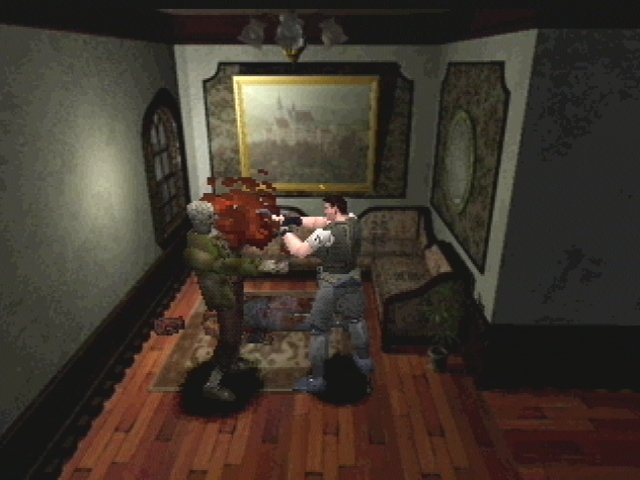
Nintendo's response to the Playstation was the Nintendo 64, still using the older cartridges, was released in 1996. This time Nintendo didn't steal the market, Sony had already done that with clever marketing and an earlier release and because of this Nintendo was playing catch up for the first time. (Scullion C, 2009) Resident Evil was released for the Playstation in '96, using pre-rendered backgrounds and real-time poly models for the characters. 1997 saw Golden Eye released for the Nintendo 64, created by Rare the game was a massive success and now has a lasting legacy. Final Fantasy 7 was also released  in '97 for the Playstation and in 1998 The Legend of Zelda: Ocarina of Time was released for Nintendo's console. Both consoles had their fair share of great games.

Resident Evil - "I bet you're dying to smell these roses!" [5]

Sega in 1998 also had their last attempt at market domination with the release of  the Dreamcast. The console didn't launch well in either Japan or America, but in Europe, Sega's strongest region, the Dreamcast shattered records. The launch line-up was probably one of the best ever, but after this the games couldn't keep up with the likes of Mario and Metal Gear and the company was hemorrhaging money in the US and Japanese markets. When Sony released the Playstation 2 in 2001 this spelled the end for the Dreamcast, the decision was made to stop production of the Dreamcast and focus on making games for other consoles. (Fahs T, 2010)

During the 90's Bandai were also releasing consoles, but they didn't stop the epic battle between Nintendo, Sega and Sony. The 00's saw another competitor step into the gaming market to essentially create the 3-way console war that we have right now, all the while PC gaming is still sitting in the background, not effected too much by the shifting console market yet never rising to the top either.


References & Notes
Fahs, T. (2010). IGN Presents the History of Dreamcast. Available: http://uk.ign.com/articles/2010/09/10/ign-presents-the-history-of-dreamcast?page=10. Last accessed 15th Nov 2013.

Raiford, Guins. (2009). Concrete and Clay: The Life and Afterlife of E.T. The Extra-Terrestrial for the Atari 2600.. Design and Culture. 1 (3), 345-364.

Scullion, C. (2009). History Of Nintendo: N64. Available: http://www.officialnintendomagazine.co.uk/12769/features/history-of-nintendo-n64/. Last accessed 15th Nov 2013.

Scullion, C. (2009). History Of Nintendo: SNES. Available: http://www.officialnintendomagazine.co.uk/12580/features/history-of-nintendo-snes/. Last accessed 15th Nov 2013.

http://www.nintendo.com/corp/history.jsp

http://classicgames.about.com/od/history/a/Atari2600Histor_2.htm

http://www.atariage.com

http://en.wikipedia.org

http://us.playstation.com/corporate/about/theplaystationstory/

[1]http://killscreendaily.com/articles/interviews/creator-worst-videogame-world-sees-
new-life-bdsm-film-and-therapy/
[2]http://www.gameinformer.com/b/features/archive/2012/11/10/replay-alex-kidd-in-miracle-world.aspx
[3] http://www.officialnintendomagazine.co.uk/viewer.php?mode=article&id=24541
[4]http://www.wired.com/images_blogs/gamelife/2012/09/ps1.jpg
[5]http://cdn.mashthosebuttons.com/wp-content/uploads/2012/08/resident-evil-1.jpg

Friday, 1 November 2013

History of Gaming: Part 2.

As promised the next part of my look into the history of gaming will actually involve more on games, with Spacewar being created in the early 60's this paved the way forward for the video gaming scene. Spacewar was so popular that the PDP computers it was built for began shipping it with every machine as a tester program, this made Spacewar a standard in universities and industrial laboratories. Video gaming wasn't out in the open public just yet, as it was restricted to only places with enough money to buy the machines but one man wanted this to change.

After playing Spacewar at University, Nolan Bushnell, a 1968 Utah graduate, had the idea to create an arcade game similar to Spacewar but for fairly priced computers, however this was not doable at the time, as an entire PDP system costed over $100,000. Luckily over the course of the development the cost of this technology improved and the price dropped. The game was titled Computer Space. It wasn't suited for arcade play, as the game was too complicated but the actual cabinet that Computer Space came in set the standard for the future arcade machines. Computer Space was released in 1971 and it was quite clear that this game would not be the hit they wanted it to be. (Lowood, 2009)

Computer Space - Lady in night dress not included [1]

Bushnell and his business partner Ted Dabney founded a new company off the failure of Computer Space. The company was called Syzygy, later renamed to Atari, and had attracted another engineer named Al Alcorn. Bushnell gave Alcorn the task of creating a simple ping-pong game. After a couple of months Alcorn had a working prototype using a standard TV and a couple of other components. (Lowood, 2009)

Pong prototype [2]

The prototype was installed in a local tavern and people queued up to throw coins into it. Pong was a huge success, unlike Spacewar and Computer Space, because it was very simple to understand and play. The entire cabinet was also much cheaper to build, even if it didn't look a funky as the Computer Space cabinet. (Lowood, 2009) By 1972 the Pong cabinets were being sold and this set up Atari to be a major player in the early computer game industry. Following Atari's success many other companies entered the market with their own cabinets, but they struggled to dethrone Atari at this stage. (Haddon, 1987)

During the early 70's the companies like IBM, HP and Xerox had been improving the computer immensely. The size of the computers had now come down to almost desktop size and were beginning to shift from needing multiple people running them to just one. Xerox played a huge role in the advancement of computers with their Pale Alto Research Center (PARC). Away from the peering eyes of the corporate minds the people at PARC were free to think and invent, coming up with a huge range of things, such as laser printers, bitmaps and the Ethernet. One researcher in particular, Charles P. Thacker had created the first personal computer, the Alto, which had a lot of the same functions as a modern PC. (Anthes, Thacker, 2010)

The Alto, almost like a desktop [3]

In 1973 Steve Colley, a NASA intern, had the idea to place people inside a 3D maze using the computers at his disposal. The game wasn't exactly fun to play, yet a couple of Colley's co-workers saw potential in it. They had the idea to place multiple people inside the maze and eventually the idea came about to shoot each other, this was the birth of the FPS, Maze Wars. In '74 Greg Thompson, one of Colley's co-workers, had taken Maze Wars back to MIT where he upgraded it to run on an early version of the internet, using the Alto computer. This caused Maze Wars to explode in popularity as people battled across the MIT and Stanford campus. Maze Wars was picked up by Xerox and it was upgraded and ported to many different computers for over a decade. (Olivetti, 2012)

More like Amaze-Wars! [4]

Atari in 1975 had released the home version of Pong. Bushnell had got computer gaming to the mass market thanks to the inventor Ralph Baer. Baer had created a TV console with a ping pong game, a chase game and even a shooting rifle, the console was named the Magnavox Odysseey and during the Christmas of 75 was in direct competition with the Atari console. Due to Baer patenting the TV videogame during it's creation there were many legal battles throughout the late 70's and the 1980's as he tried to protect his idea. (Lowood, 2009)

Atari's home console was a short term success but people began to lose interest after a while with only one game. The development time for these single-game consoles was also rather long, meaning gamers had droughts. Atari's engineers had come up with the idea to have interchangeable cartridges and in 1977 the VCS Prototype was created, by the end of 77 the Atari 2600 was released. The 2600 did not sell amazingly until 1980, when Atari brought the rights to Space Invaders off Midway. Space Invaders at the time was an arcade only game but still very popular and porting it over to a home console made it a massive hit. (Driscoll, 2002)

The Atari 2600, with modern wooden paneling [5]
The cold war was still dominating Russia, and continued to do so through out the 80's. Even today the Eastern European countries are not well known for their computer skills, with only a handful of video game development companies releasing anything noteworthy. This could be due to the problem of getting the needed equipment into the countries, because of things like "thieving customs officials" and other problems like that. (Rubin, 2013) Japan's silence however was about to be broken, as the 80's brought about the end of the US dominance in the video game industry, which I will look into in part 3.


References & Notes
Edward B Driscoll. (2002). The Atari 2600: The Cartridge Family Rides Again.. Poptronics. 3 (3), 23.

Gary Anthes, Charles P. Thacker. (2010). Committed to Success..Communications of the ACM. 53 (2), 22-23.

Jason Rubin (2013). Jason Rubin: Metro: Last Light is the "triumph of an underdog". Available: http://www.gamesindustry.biz/articles/2013-05-15-jason-rubin-metro-last-light-is-the-triumph-of-an-underdog?utm_source=newsletter&utm_medium=email&utm_campaign=us-daily Last accessed 1st Nov 2013

Justin Olivetti. (2012). The Game Archaeologist: Maze War. Available: http://massively.joystiq.com/2012/06/12/the-game-archaeologist-maze-war/ . Last accessed 30th Oct 2013.

Henry Lowood. (2009). Videogames in Computer Space: The Complex History of Pong.. IEEE Annals of the History of Computing. 31 (15), 5-19.

Leslie Haddon. (1987). The History of an Interactive Medium. Electronic and Computers Games. 41, 52-73

Tuesday, 29 October 2013

History of Gaming: Part 1.

If you ask many people about the history of gaming they'd probably mention something fairly modern, like Spacewar! or Pong as a starting point, which were both released in the 1960's. However this isn't the true history of computer gaming. It actually starts much further back than you might think, with the Ancient Greeks and what can be described as the very first computer, the Antikythera Mechanism.

In 1900 a group of Greek sponge divers found a Roman shipwreck with various Greek treasures aboard. One of these was the Antikythera Mechanism and it took over 70 years after it's discovery to figure out what the device was correctly used for. A British physicist and historian of science named Derek de Solla Price worked out that the device was from around 100-150 BC and showed the movement of the sun and moon with great accuracy. Price also mentioned that the differential gear used in the mechanism is "one of the greatest basic mechanical inventions of all time" (Vallianatos, 2012)


A fragment of the mechanism [1]
The next step big step in computing came about many years later. In 1800 a French inventor named Joseph-Marie Jacquard was summoned by Napoleon to help improve the draw loom. The draw loom used perforated card that guided the hooks required for silk weaving. Jacquard helped speed up this process and the Jacquard head was shown to the world in 1804. It is now commonly called the Jacquard Loom. Some people however disagree with this loom being the first computer, as it relied heavily on these punch cards, making it nothing more than an advanced player piano that used the same style of punched roller card to play songs.

Almost 40 years later a British mathematician named Charles Babbage had become obsessed with creating a machine to help him with mathematical tables. His first creation, the Difference Engine could have been built if it wasn't for a number of difficulties, such as late payments from the government and a dispute with his craftsmen. Babbage soon began working on a more advanced machine, the Analytical Engine, and quickly forgot about the Difference Engine. The Analytical Engine used cards in a similar way to Jacquard Loom but could store data on them and also plan out the next set of actions depending on various outcomes. Due to technical limitations of the time Babbage never got to see his machine created, but it was recreated years after by a group at Harvard. (Davis, 2005)

Charles Babbage's Analytical Engine [2]

After this the computers begin looking more like the machines everyone expect and (mostly) run off electricity. In 1939 Hewlett Packard had made their first machine, an audio oscillator. Walt Disney was so impressed he bought 9 for the sound presentation of Fantasia and this was the big order that made them formally go into business together. (Microwave Journal, 2008) The computers around this time were all built for a single purpose, with a single task in mind for a company or government. A good example of this is the Colossus, a machine built to crack the enigma code during the World War 2 or the ENIAC. The ENIAC started its life as a ballistic trajectory table for the US military but was later revised for storing programs, such as monitoring finance or stock. (Neukom, 2006)

The ENIAC [3]
So far we've covered almost 2000 years of computing yet not come across any gaming. This is for a number of reasons. The first reason being that computers of this time were the laughable size of filling multiple rooms, the second being that this was still new technology and even in the 1940's had only scratched the service of what computers can do. Lastly like I mentioned earlier computers were only being built by governments or at a high corporate level, that leaves little room for experimentation. This all began to change when Universities got hold of the computers.

In the 1960's a group of the MIT railway club began taking an interest in computer systems to do with telephones and railways, this lead them to begin experimenting with the computers themselves and the term hacking was coined. These hacks would test a computers capabilities but weren't any use by themselves. (Haddon, 1987) February 1962, Steve Russell, Alan Kotok, J. Martin Graetz and others from the MIT railway club demonstrated a new computer by creating Spacewar! The program had you control a spaceship and you'd have to fire at opponents. The code was shared across the entire MIT campus and it was greatly added to and improved on. The program showcased the new computer perfectly and also showed what the programmers could do with these machines... video gaming was now officially born. (Lowood, 2009)

Spacewar! played on the PDP-1 [4]
At this point the people involved are all from the West, mainly America and Britain. Russia at this time was still deep in communism and in a cold war with the U.S, this made it very difficult to get any information past the iron curtain as Russia tried to make itself independent from the western countries. Japan, now such a major player in the electronics industry, was in the 1960's playing catch up in the 1960's. IBM had just released 3 computers for various roles, the 7070, 7090 and the 1401. The 1401 is one of the most successful computers in the world and Japan recognized this, they had identified that they were at least 10 years behind and wanted to catch up quickly. (Takahashi, Weiss, 1996)

I shall end this post here to try and keep scrolling to a minimum. Part 2 will have more about gaming... I promise!


References & Notes
Evaggelos Vallianatos. (2012). Deciphering and Appeasing the Heavens: The History and Fate of an Ancient Greek Computer. Leonardo. 45 (3), 251-252.

Hans Neukom. (2006). The Second Life of ENIAC.. IEEE Annals of the History of Computing. 28 (13), 4-16.

Henry Lowood. (2009). Videogames in Computer Space: The Complex History of Pong.. IEEE Annals of the History of Computing. 31 (15), 5-19.

Leslie Haddon. (1987). The History of an Interactive Medium. Electronic and Computers Games. 41, 52-73

Martin Davis, Virginia Davis. (2005). Mistaken Ancestry: The Jacquard and the Computer.. Textile: The Journal of Cloth & Culture. 3 (1), 76-87.

Sigeru Takahashi, Eric Weiss. (1996). A brief history of the Japanese computer industry before 1985.. IEEE Annals of the History of Computing.. 18 (4), 76.

Unknown. (2008). HEWLETT-PACKARD COMPANY Palo Alto, California..Microwave Journal. 51 (4), 120-126.

[1] Image sourced from http://www.computus.org/journal/?p=155
[2] Image sourced from http://www.sciencemuseum.org.uk/objects/computing_and_data_processing/1878-3.aspx
[3] Image sourced from http://www.library.upenn.edu/exhibits/rbm/mauchly/jwm8b.html
[4] Image sourced from http://www.wheels.org/spacewar/creative/SpacewarOrigin.html